
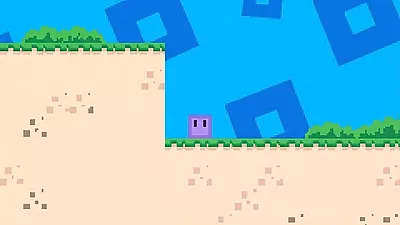
How to play?
Game Rules:
- Rule 1: The core mechanic of Replace revolves around an auto-scrolling protagonist—a purple square—whose forward momentum is entirely beyond your control. Mastery lies not in speed management, but in precise input execution.
- Rule 2: Progression is predicated on timely screen taps to execute jumps, bypassing incoming obstacles and environmental hazards.
- Rule 3: Replace utilizes a unique iteration system. In specific levels granting multiple lives, a failure results in the permanent placement of a 'grey corpse'—a static representation of your previous run's termination point.
- Rule 4: These static corpses are not mere fail states; they are critical strategic assets. They function as solid platforms, altering the level geometry and enabling access to otherwise unreachable vertical elevations on subsequent attempts.
- Rule 5: Collision detection is unforgiving. Any contact with the lateral edges of blocks or the pointed extremities of spikes triggers an immediate fail state, demanding pixel-perfect precision.
- Rule 6: Optimal play requires a paradigm shift: viewing 'deaths' not as failures, but as necessary sacrifices to construct an improvised, navigable path to the objective.
Controls:
- Action: A single tap initiates a jump. Consistent, rhythmic tapping is crucial for maintaining flow through dense obstacle clusters.
- Action: Strategic deployment of failure states is key. Intentionally ending a run at a specific locus to place a 'grey corpse' platform requires calculated timing and situational awareness.
Replace Similar Games
If you enjoy this game, you might also like these games with similar gameplay.
FAQ:
- Q: Is there any way to manipulate the cube's forward velocity?
- Q: How do the 'grey corpses' factor into strategic planning?
- Q: Are the number of lives consistent across the entire game?
No. The cube's auto-scroll speed is a fixed variable. Strategic focus must remain entirely on jump timing and platform creation via intentional failures.
They are essential for progression in complex levels. By intentionally failing at specific points, you construct a custom staircase or bridge of corpses, fundamentally altering the level's topology to facilitate completion on a later run.
Life counts are level-dependent. Certain stages are balanced around single-life precision, while others necessitate the strategic sacrifice of multiple lives to build a navigable path.


Comments
Be the first to comment!